Biomedical Deep Learning
Developed convolutional neural network models to classify ECG signals and identify patterns in time-series data.
Deep Learning · Biomedical Signal Classification
A deep learning project exploring automated electrocardiogram classification through neural network architectures, signal preprocessing, and performance evaluation.
The Project
Electrocardiograms (ECGs) record the electrical activity of the heart. Analyzing these signals can help identify patterns associated with different cardiac rhythms, making them an interesting application of machine learning to biomedical data.
I developed and evaluated deep learning models for ECG classification using publicly available electrocardiogram datasets. The project involved preparing time-series signals, experimenting with neural network architectures, and evaluating how effectively the models distinguished between different classes.
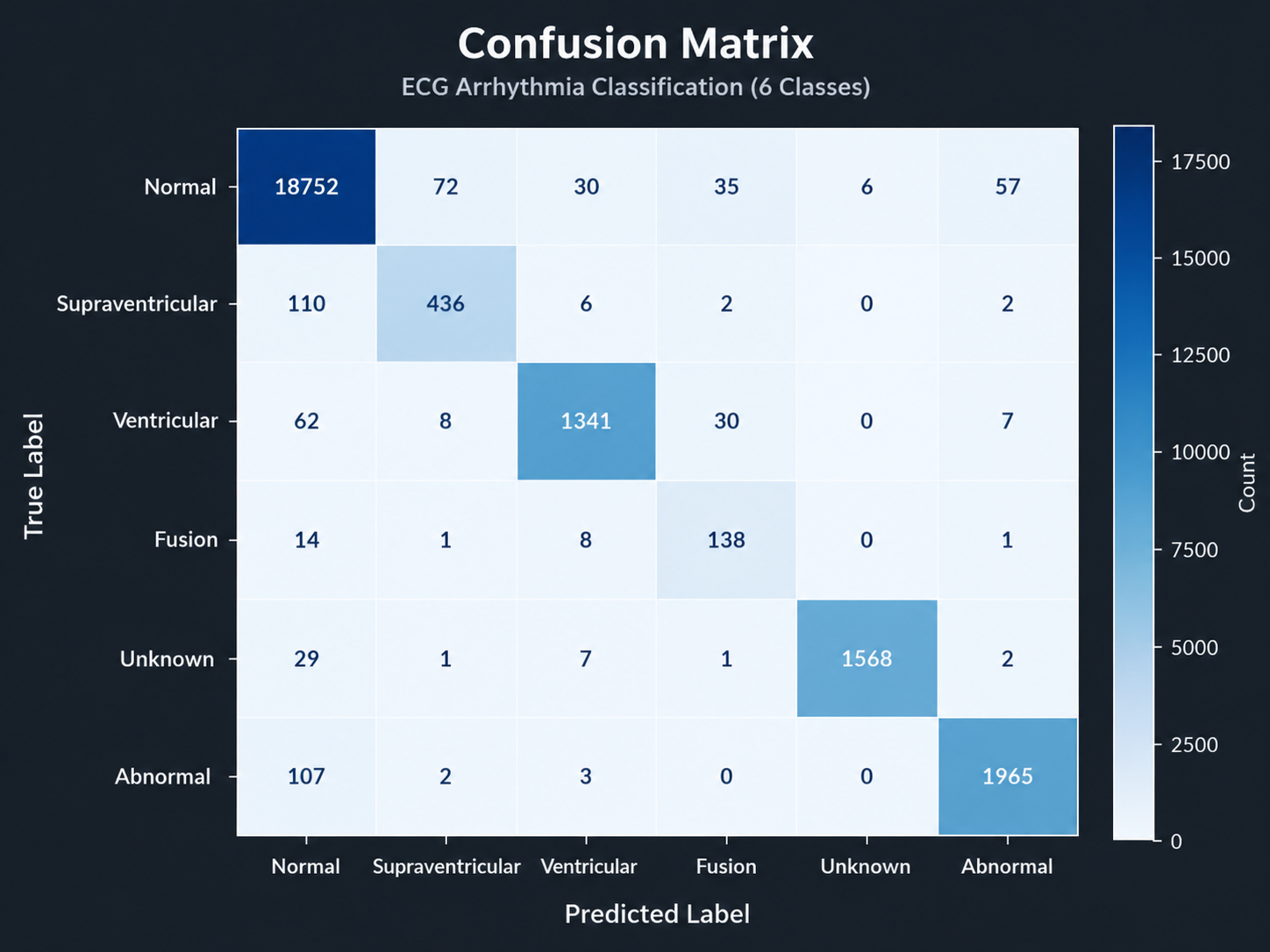
Beyond overall classification accuracy, I focused on understanding model behavior across classes, particularly when some categories were represented less frequently than others.
This project brought together biomedical signal processing, deep learning, and statistical evaluation.
Key Contributions
Developed convolutional neural network models to classify ECG signals and identify patterns in time-series data.
Prepared ECG datasets for neural network training, including label handling and consistent input formatting.
Evaluated classification performance using metrics beyond accuracy, with attention to class imbalance and minority-class performance.
Behind the Build
Electrocardiogram classification is a machine learning problem involving time-series signals that represent the electrical activity of the heart.
The objective of this project was to explore whether deep learning models could learn useful representations of ECG signals for classification.
A secondary objective was to understand how model architecture and dataset characteristics influence performance across different classes.
The project used ECG data from the MIT-BIH Arrhythmia Database and the PTB Diagnostic ECG Database.
Preparing the data involved organizing signal samples, reviewing class labels, and ensuring the inputs were suitable for neural network training.
Consistent preprocessing was important because neural networks require predictable input shapes and label representations.
I also considered the effects of class imbalance when interpreting evaluation results.
I implemented a one-dimensional convolutional neural network (1D CNN) to learn patterns directly from ECG signal sequences.
Convolutional layers are well suited to this type of data because they can identify local signal features without requiring manually engineered features for every waveform characteristic.
I also explored recurrent neural network approaches as a comparison, examining how different architectures process sequential information.
The project provided experience selecting and evaluating model architectures for structured time-series inputs.
Model development involved training neural networks on labeled ECG signals and evaluating their predictions on held-out data.
One challenge was that some classes appeared less frequently than others, which can cause a model to favor more common categories.
I experimented with class weighting to give additional importance to underrepresented classes during training.
This process reinforced the importance of evaluating models according to the actual classification problem rather than optimizing a single aggregate metric.
I evaluated model performance using classification metrics including accuracy, precision, recall, and area under the receiver operating characteristic curve (AUC).
Class-level evaluation was especially important because strong overall accuracy does not necessarily indicate reliable performance for less common categories.
I compared model behavior across classes and examined how training choices affected the balance between different performance measures.
These evaluations were conducted as part of a machine learning project and should not be interpreted as clinical validation.
This project strengthened my understanding of deep learning for time-series classification, particularly the relationship between model architecture, data preparation, and evaluation.
It also demonstrated the importance of selecting metrics that reflect the consequences of different types of classification errors.
Potential future improvements include broader cross-dataset testing, systematic hyperparameter optimization, model interpretability techniques, and evaluation on additional ECG recordings.
The models are research and educational demonstrations, not clinically validated diagnostic tools.