Scientific Investigation
Contributed to research investigating microsaccade behavior using experimental eye-tracking recordings.
Scientific Computing · Statistical Analysis
Computational research involving experimental eye-tracking data, automated microsaccade detection, feature extraction, and statistical analysis. Specific findings are not yet public.
The Research
Eye-tracking technology provides researchers with measurements that can be used to study subtle patterns in human visual behavior. Microsaccades, which are small eye movements occurring during fixation, are one example of the features that can be extracted from these recordings.
As part of a research collaboration involving Inception Labs and Keimyung University in South Korea, I worked with experimental eye-tracking data and developed computational workflows to support microsaccade research.
My contributions included implementing detection methods, organizing participant-level measurements, conducting statistical analyses, and preparing visualizations to communicate the work.
The experience brought together programming, statistics, and scientific reasoning in a collaborative research environment.
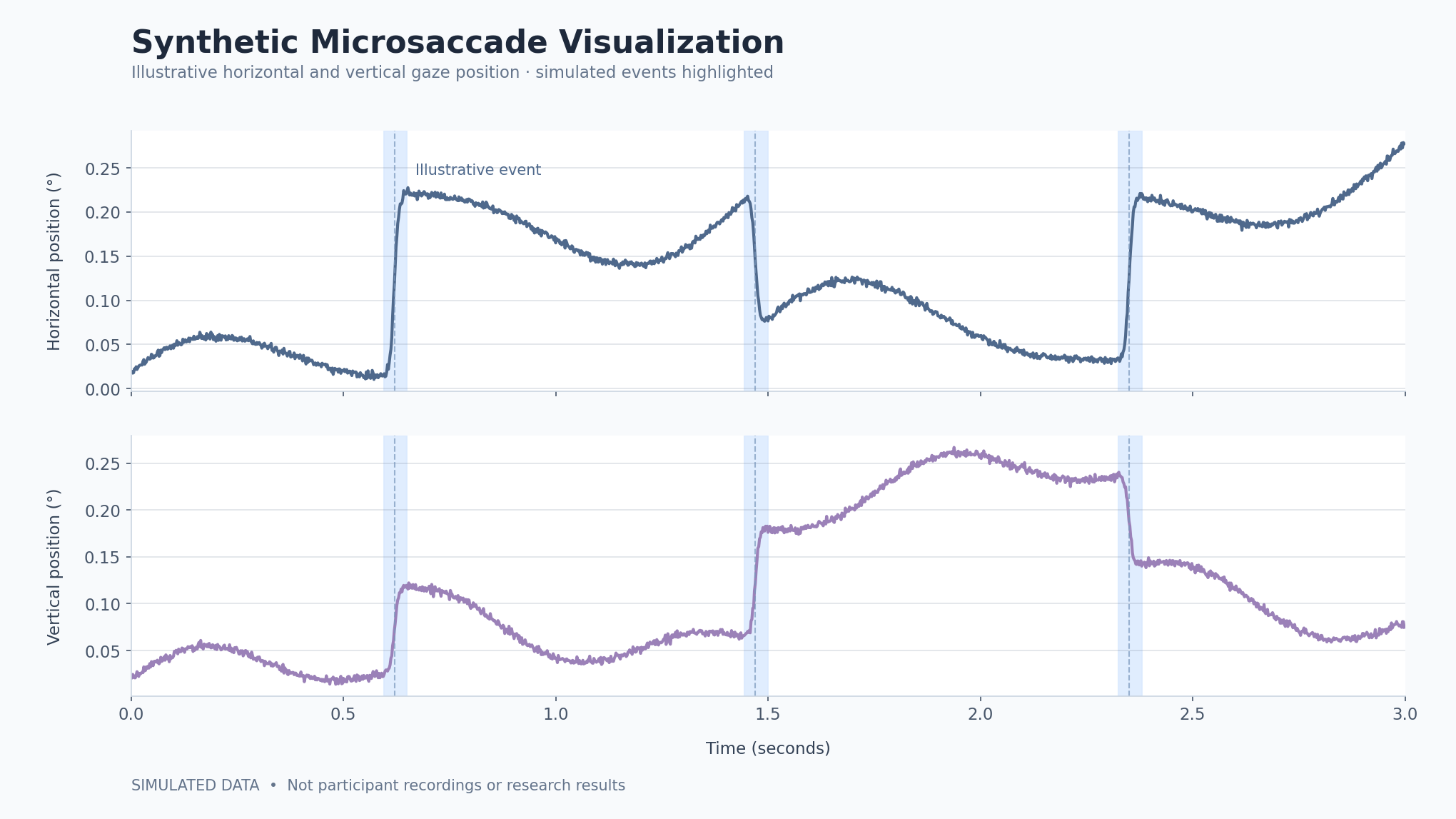
Visualization note: The eye-tracking signals shown in the project image were generated using synthetic data for illustrative purposes. They do not represent actual participant recordings or findings from the research.
Key Contributions
Contributed to research investigating microsaccade behavior using experimental eye-tracking recordings.
Developed workflows to process eye-tracking recordings, detect microsaccades, and extract features for statistical analysis.
Applied statistical methods to evaluate experimental measurements and support evidence-based research interpretation.
Behind the Build
Microsaccades are small, involuntary eye movements that occur during visual fixation. Their characteristics can provide information about visual and oculomotor processes.
This project involved analyzing experimental eye-tracking recordings to investigate patterns in microsaccade behavior.
My work focused on developing computational methods for extracting relevant measurements and supporting the statistical analysis of experimental data.
Specific study findings are not included because the research results have not yet been made public.
Experimental eye-tracking data requires careful preprocessing before meaningful measurements can be extracted.
I worked with eye-tracking recordings and developed workflows to organize the data into formats suitable for automated analysis.
An important part of this process was maintaining consistency across recordings so that extracted measurements could be analyzed systematically.
I implemented a computational approach to microsaccade detection based on the Engbert–Kliegl velocity-based method.
The workflow used eye-movement velocity to identify candidate events and incorporated additional criteria for event selection.
After detection, the pipeline extracted relevant measurements and organized them into structured datasets for downstream analysis.
This work required translating a research methodology into a repeatable computational process.
I used Python and R to support statistical analysis of the extracted eye-movement measurements.
The analytical workflow included methods such as analysis of variance (ANOVA) and post-hoc comparisons to investigate differences within the experimental data.
My responsibilities included preparing analysis-ready datasets, performing statistical calculations, and generating visualizations to support interpretation.
The specific comparisons, numerical results, and conclusions are intentionally omitted pending public release of the research findings.
One of the central technical challenges was transforming experimental recordings into structured measurements suitable for statistical analysis.
Developing an automated processing workflow helped make the analysis more consistent and reduced the need for repetitive manual processing.
The project required careful attention to detection criteria, data organization, and the relationship between computational outputs and their scientific interpretation.
It also reinforced the importance of building analysis workflows that can be reviewed, refined, and repeated.
This project strengthened my ability to work with experimental datasets and implement computational methods in a scientific research environment.
I gained practical experience connecting data processing, algorithm implementation, statistical analysis, and research communication.
The experience also reinforced the importance of interpreting analytical results carefully and distinguishing between observed patterns and conclusions supported by evidence.
Research findings and supporting figures may be added to this portfolio after they become publicly available and are approved for sharing.